Twin Paradox Explained with the Light Clock
The Twin Paradox describes how one twin, traveling with non-trivial speed for some time and returning back home, is then younger than his twin. This is explained in detail by Special Relativity physics. See the Wikipedia Twin Paradox page, for example.
On this page you find wording like "...clock is running slow...". How's that? The explanation I can grok most easily makes use of the Light Clock.
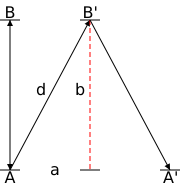
While in the stationary clock, light is bouncing at full speed $c$ between $A$ and $B$, in the moving clock, as viewed from the stationary frame, the light has to travel the path $A\to B' \to A'$. To travel the distance $d$ between $A$ and $B'$ it needs a time $t$ such that $d/t = c$. The distance $d$ can be partitioned into a forward move of the clock by $a$ and the clock size $b$ such that $d^2 = a^2 + b^2$. Divide by $t^2$ to get $$d^2/{t^2} = c^2 = (a/t)^2 + (b/t)^2\,.$$ The term $a/t$ is the speed of how fast the clock is moving, call it $v$. And $b/t$ is the speed left for the light clock to actually tick. Call it $c'$ to get $$ c' = \sqrt{c^2 - v^2}\,. $$
This $c' < c$ is how the light clock runs slower. And not only the clock. The clock is a viable measure of time, so time actually runs slower. How? Well! One way I intuit this is to imagine that my body, as a rough biological clock, ticks by means of metabolism, which comes down to chemical reactions, which again are based on the exchange of electrons in atoms and molecules, which again requires the exchange of virtual photons which $\dots$ are light.
A simple, striking way to say it is: when moving, the light clock gets busy with moving so it has less resources to tick.